SEO White Hat vs Black Hat: Explained
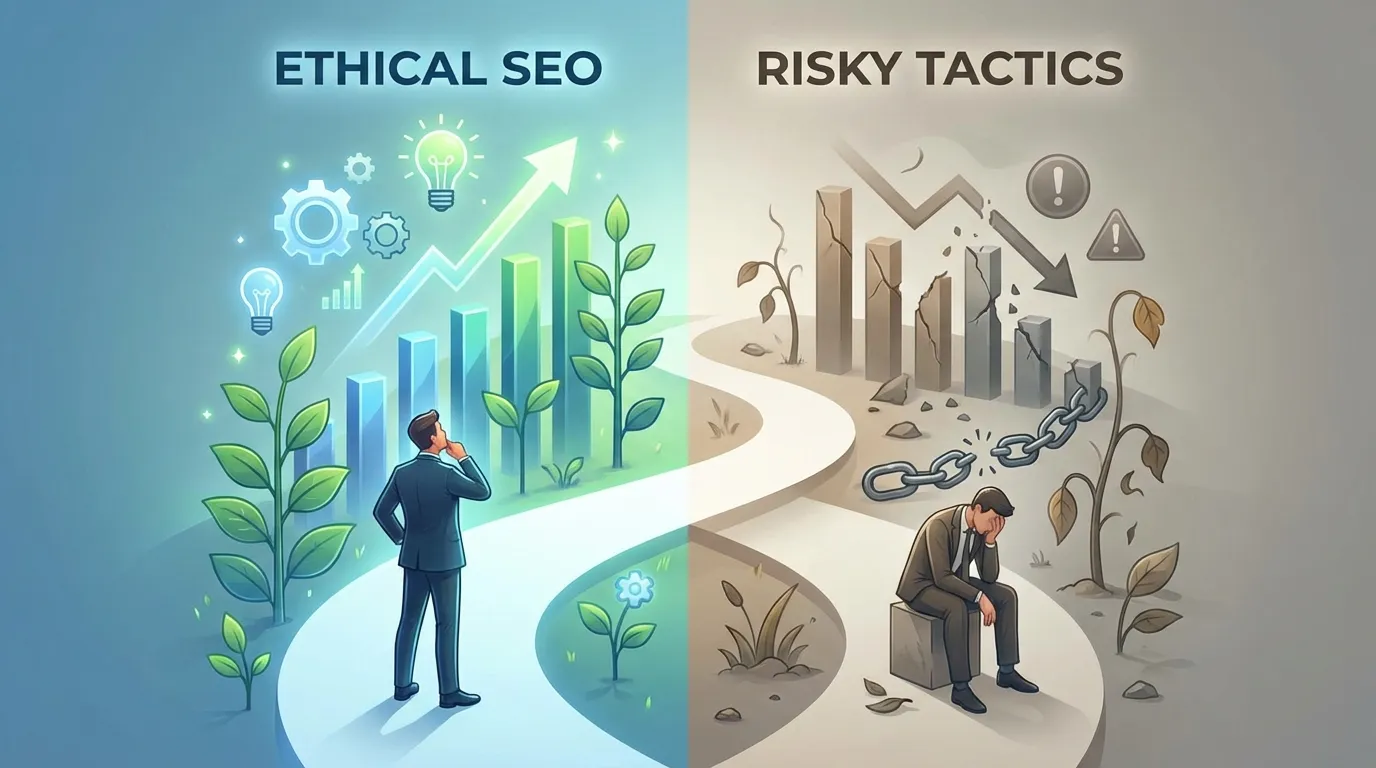
SEO often looks simple at the start. You publish content and hope it shows up on Google so people can actually find you (usually through search results, not magic). Sounds easy enough. But once teams move past the basics, things get complicated fast, often sooner than expected. Before long, there’s a real decision to make. A big one. It usually comes down to choosing white hat search engine optimization or heading toward black hat SEO (and yes, that choice matters more than many people think).
That decision carries more weight today than it did a few years ago. Google is much smarter now, and AI tools are part of daily marketing work for many teams (probably yours, too). The rules and expectations have changed. Tactics that once slipped by now come with real business risk. For SaaS teams and e‑commerce brands trying to grow online, one bad SEO choice can undo years of steady progress, sometimes in just weeks. It happens faster than most people expect.
If “black hat vs white hat” has ever felt confusing, you’re not alone. These terms get used everywhere (Twitter threads, sales calls, blog posts). They’re often oversimplified, sometimes used to scare people, and frequently tied to tools or services promising fast results. Speed can be tempting, but it rarely means safety, and it usually doesn’t last.
Instead of rushing, this guide takes a slower approach and explains things in plain language (no heavy jargon). The focus stays practical. It looks at what white hat vs black hat SEO actually means, how SEO black hat techniques work, why they tend to fall apart over time, and how modern white hat SEO strategies usually help brands grow safely at scale without putting their site at risk. The goal is better decisions, not quick ones.
It also looks at where AI fits and where gray areas often show up (because some lines really are blurry). Along the way, it explains why platforms like SEOZilla.ai stick to a strict white hat approach, even when that means saying no to tempting shortcuts like backlink exchanges.
What White Hat and Black Hat SEO Really Mean
At its base, SEO is about helping search engines understand what a page is about and making it easier for real people to find answers when they’re already searching. Most people agree on that starting point. Where opinions split is how that goal gets pursued. White hat and black hat SEO are two very different ways to reach the same end, and that difference usually matters more than it seems at first.
White hat search engine optimization follows the rules search engines publish and enforce, often called webmaster guidelines or spam policies. The focus stays on real users and on results that grow steadily over time. Instead of hype or shortcuts, the work is about being useful. Rankings rise because a site keeps publishing relevant, clear, and updated content, things like straightforward explanations and real examples. That’s why these results usually stick around longer.
Black hat SEO goes in another direction. Rather than improving things for readers, it tries to push search engines into ranking pages higher through manipulation. The draw is speed: fast wins, quick visibility, and traffic spikes that look great in analytics. Often, those gains fade. Once tactics get flagged, and that happens more often than many expect, the drop can be sharp.
So how can you tell the difference in real situations? A simple way is to ask who benefits most. If a change truly makes the page better for someone reading it, it’s usually white hat. If it mainly exists to fool an algorithm, it’s usually black hat. There isn’t much gray area once you really look.
Examples help. Answering real customer questions in blog posts is white hat. Repeating the same keyword in every sentence just to rank is black hat. Making pages load faster helps users right away, that’s white hat. Hiding text in the background to rank for extra terms is black hat and usually easy to catch.
Search engines have been consistent here. Helpful, honest content made for people gets rewarded. Deceptive tactics tend to lead to penalties, sooner or later.
What often gets missed is intent. White hat SEO works with search engines, users, site owners, and brands. Black hat SEO depends on not getting caught, which gets riskier as algorithms keep getting better.
Black hat SEO is not worth the risk. Google’s algorithms are increasingly effective at detecting manipulation, and recovery from penalties is never guaranteed.
That risk shows up in real ways: traffic that doesn’t return, revenue hits that hurt, and trust that’s hard to rebuild even after the site is fixed.
Common Black Hat SEO Techniques and Why They Fail
To understand the risk, it helps to slow down and look closely at the black hat SEO techniques that keep showing up. Many of these tactics promise fast wins, sudden jumps and quick rankings. That sounds appealing, and it’s easy to see why. What often gets missed is the trade-off: short-term movement that leads to long-term damage. In many cases, the consequences don’t show up right away, which is why teams are surprised when problems surface later.
Keyword stuffing is one of the most familiar examples. It means forcing keywords into content until the writing feels awkward or repetitive. Years ago, this could sometimes push a page higher. Today, it usually does the opposite by sending a clear spam signal, and rankings tend to fall. When a real person reads the page, it’s often obvious something is wrong, which is part of why this tactic fails so quickly now.
Cloaking is another approach that still appears from time to time. This is when search engines see one version of a page while users see another. There’s no gray area here, it breaks the rules directly. The result is often a manual penalty tied to the site itself, and those penalties can be hard to undo once they’re in place.
Link manipulation causes trouble for similar reasons. Buying links or running private networks is about faking trust instead of earning it. That shortcut might work briefly, but it rarely lasts once patterns start to show.
Some teams also misuse AI tools by publishing large volumes of AI-generated pages with no review or original thinking. Google isn’t against AI, but it does target automated content that adds no real value, and the difference is usually easy to spot.
The fallout can be serious. Research shows sites hit by penalties often lose most of their organic traffic almost overnight. These tactics also leave clear footprints, repeated anchor text, strange publishing spikes, or the same link sources again and again. Once trust is damaged, even solid pages can struggle.
| Metric | Impact |
|---|---|
| Organic traffic loss after penalty | 70, 90% decline |
| Manual penalty recovery time | 6, 24 months |
| Full recovery rate | Less than 50% |
After trust is gone, building it back takes time, often much more time than teams expect at the start.
Why White Hat SEO Is the Safer Growth Strategy
White hat SEO often gets called slow. That idea made more sense years ago, but it doesn’t really fit anymore. When done well, modern white hat SEO usually brings steady growth that actually lasts. No tricks. Just results that grow month after month and are easy to explain to a client or boss without stress.
What really sets it apart is how the work builds over time. Each improvement supports the next. Better content makes internal links clearer. A cleaner site structure helps search engines move through pages more smoothly. A more thoughtful user experience often keeps visitors on the site instead of leaving right away. On their own, these changes might seem small, but over time they add up in ways shortcuts usually don’t. You see this pattern again and again.
White hat SEO also puts search intent first. Instead of chasing single keywords, teams focus on what people are actually trying to do or learn. Content is built around that need and written to sound natural and clear, not forced or awkward. Simple and useful. That’s often why it performs more consistently.
The technical side matters too. Clean architecture, fast load times, mobile optimization, and crawlability all matter. It’s not flashy work and it’s often ignored, but it still counts. These fixes help users move through a site and help search engines understand pages more clearly.
Link building looks different as well. Links aren’t bought or traded. They usually come from content others truly want to reference. It takes time, but those links tend to last longer and carry real value.
One benefit that doesn’t get talked about much is predictability. Because growth is built on basics instead of loopholes, teams can usually plan timelines and budgets with fewer surprises.
According to Google’s own guidance, anything meant to mislead users or search engines is a violation. Simple as that.
If an SEO technique feels deceptive or misleading to users, it probably violates Google’s guidelines and won’t work long term.
White hat SEO also cuts down on guesswork. You can usually tell why a page performs the way it does. So when algorithms change, as they always do, the foundation is still there and solid.

White Hat vs Black Hat SEO in Real Business Scenarios
Theory helps set the stage, but real business situations are usually where the gap between these approaches becomes obvious. That’s often when opinions change. I think this happens because real money, time, and stress are involved, and results stop feeling like abstract ideas you can argue about.
Take a SaaS company launching a new feature. One tempting black hat move is to create hundreds of thin landing pages for every tiny keyword variation, including phrases no real person would ever search. Traffic jumps fast, which feels exciting at first. Then rankings slip, conversions slow down, and before long the domain gets flagged. Recovery is slow and frustrating, and in many cases that’s when teams start to panic. It’s a rough cycle to go through.
The white hat path is slower, but usually less stressful. Teams look at real user questions by reviewing support tickets, emails, and chat logs. Instead of dozens of weak pages, they publish one solid, detailed guide. That guide is linked from relevant product pages where it makes sense. Time is spent on page speed, layout, and wording that’s easy to understand. Growth takes longer, but traffic tends to stick and turn into signups, which often makes the slower pace worth it.
E-commerce shows a similar pattern. Black hat sellers may use expired domains or paid links to push products fast, and it can work for a short time. When a major update hits, entire stores can disappear overnight. White hat stores move more steadily with strong category pages, product descriptions written for people, structured data, and real reviews, both good and bad. Trust builds over time, and rankings usually follow.
Service businesses feel this too. Agencies chasing quick wins with black hat tactics can land leads fast, then spend months explaining drops to unhappy clients. White hat agencies often keep clients longer because results don’t vanish after the next update, and clients usually notice that consistency.
According to Google’s search team, SEO is not about tricking systems.
SEO is about helping search engines understand and present content. Any attempt to trick the system is ultimately self‑defeating.
Where Gray Hat SEO Usually Goes Wrong
Some tactics sit in an uncomfortable middle space. They aren’t fully banned, but they carry real risk, and that’s where problems start. Teams often drift into trouble without noticing. It almost never happens in one big move. It’s slow and quiet, and by the time it becomes obvious, the damage is usually already done.
Large-scale backlink exchanges are a clear example. At first glance, they look harmless. Two sites swap links, nothing breaks, and rankings might even move up a bit. The issue begins when the same approach is repeated across dozens of clients. What felt minor can quickly turn into a network that’s easy to spot. Patterns form, and they don’t take long to show.
Search engines are very good at finding those patterns over time. Links created mainly to push rankings often lose value, and sometimes they cause bigger problems. In tougher situations, they can lead to penalties that are hard to undo. And yes, those hurt.
Another gray area is aggressive content scaling without strong quality checks. Pages may be technically unique, but the site feels thin when intent, usefulness, and depth are missing. Users usually pick up on that pretty quickly.
This is why SEOZilla sticks to a strict white hat approach. The platform avoids backlink exchanges between clients. That option can feel tempting in the short term, but it often slips into gray hat territory and puts every site involved at risk.
Instead, the focus stays on content quality, smart internal linking, and technical SEO details like site structure and crawlability. Automation supports this without crossing ethical lines. Clean and steady, in my view.
Gray hat tactics often fail for a simple reason. They scale risk much faster than value. What seems fine on one page can cause real damage when spread across a full domain, and that damage adds up fast.
How AI Fits Into White Hat SEO Today
AI has changed how SEO teams work each day, often more than people expected, especially for content teams. Even so, the basic rules of SEO usually stay the same, and they aren’t changing anytime soon.
When it’s used well, AI fits neatly into white hat SEO. It can speed up topic research and keep messaging consistent across pages, helping teams publish more without burning out. When it’s used badly, though, AI often leads to shallow pages that feel rushed and spammy.
The real difference, in my view, usually comes down to governance. Clear brand rules, human review, and solid technical basics keep sites stable and easy to index. Without that oversight, black hat use often means pushing AI content live with no review at all.
Platforms like SEOZilla.ai follow this approach. AI handles early drafts, internal links, and CMS publishing, while people stay in charge of quality and voice, which is where trust shows up.
AI also helps with accessibility and clarity by simplifying language, breaking up long articles, flagging gaps, and making pages easier to scan.
Choosing the Right SEO Tools and Partners
Tools don’t decide if SEO is white hat or black hat. The difference usually comes from how they’re used. That may sound obvious, but it often gets missed. Plain and simple, that’s how I see it.
What stands out is how fast warning signs show up. Promises of instant rankings, guaranteed traffic next week, or “secret” tricks that sound too clever (you’ve probably seen those emails) usually point to manipulation, not a real plan. Those claims are worth paying attention to.
White hat tools focus on work that lasts. Content planning tied to real business goals, internal links that help users find things, and technical audits with performance tracking all fit here. It’s not flashy, but it tends to pay off over months, not days.
For growing teams, scale often decides things. Managing multiple sites and brands across different CMS platforms works better with clear structure. Automation should handle reporting and tagging, so people stay in control.
Partners matter as much as tools. Good agencies or platforms explain how results happen and how tactics follow guidelines. No mystery, no smoke, just steady work, like improving site speed and content quality.
Questions People Often Ask
Yes. AI content is white hat when people check it and it fits search intent, that matters most. It works best when it’s helpful, short, and clear. Problems usually show up when large-scale automation runs unchecked.
A 70, 90% traffic drop can feel like a huge hit (you really feel it). Recovery often takes months with no guarantee, especially after serious violations. When that happens, the most practical next step is rebranding (or moving to a new domain).
But not always. Large-scale or automated backlink swaps can slide into gray or black hat areas, because search engines look for unnatural link patterns at scale, not one-off links. In real use, context and intent usually decide what’s okay.
At SEOZilla.ai, the focus is on white hat SEO and keeping things simple, no tricks involved. I believe swapping backlinks between clients can send network signals that raise penalty risk, so it’s avoided.
The Bottom Line on Sustainable SEO
What often gets missed is that white hat vs black hat SEO isn’t a moral debate. It’s a business choice that shapes how stable growth feels over time, something many teams only understand after things go wrong.
Black hat SEO relies on staying just ahead of detection, and that window keeps shrinking every year, usually faster than people expect. Penalties show up sooner, recovery drags on, and brand damage can stick around. Rankings drop, and they rarely bounce back fast.
White hat search engine optimization takes another route. It builds things that last. Useful content and a clean site structure grow together, page by page, along with trust that search engines pick up over time. AI can help with scale if the rules are clear and people stay involved, editing, reviewing, and deciding what actually helps users. That’s often where the real value is.
There’s spillover too. Sustainable SEO often supports other channels. Good content can raise conversion rates and give email campaigns more than generic blasts. Brand authority grows outside search results as well, slowly and steadily.
For SaaS teams, online stores of any size, and companies focused on growth, quick wins are tempting. But steady growth usually matters more, even short term. So think about this: methods that survive the next algorithm update are usually the ones worth keeping.