Is Ahrefs DR the Same as Moz DA? A Data-Driven 2026 Breakdown

Few SEO debates cause quite as much head-scratching as the one on whether Ahrefs DR is the same as Moz DA. On first pass, they look more or less interchangeable: both Ahrefs Domain Rating (DR) and Moz Domain Authority (DA) are widely used metrics that range on a scale of 0 to 100, and both claim to help marketers evaluate website strength. But despite these similar traits, they measure fundamentally different things, and understanding those differences can directly impact your digital marketing decisions.
For Martech professionals and SEO content creators who rely on precise data to drive their SEO strategy, knowing whether Ahrefs DR is the same as Moz DA is more than a matter of simple curiosity and keeping tabs on industry know-how. It can spell the difference between pursuing high-value opportunities and wasting resources chasing misleading numbers.
In this breakdown, we’ll take a look at how DR and DA really differ – not just theoretically, but in the ways they show up in day-to-day SEO decisions. We’ll go over what each metric actually measures and how they correlate with real-world rankings, analyse insights from industry leaders, and look at practical strategies for integrating these metrics into an AI-driven SEO workflow heading into 2026.
The best place to hide a dead body is page 2 of Google search results.
How does Ahrefs DR compare to DA?
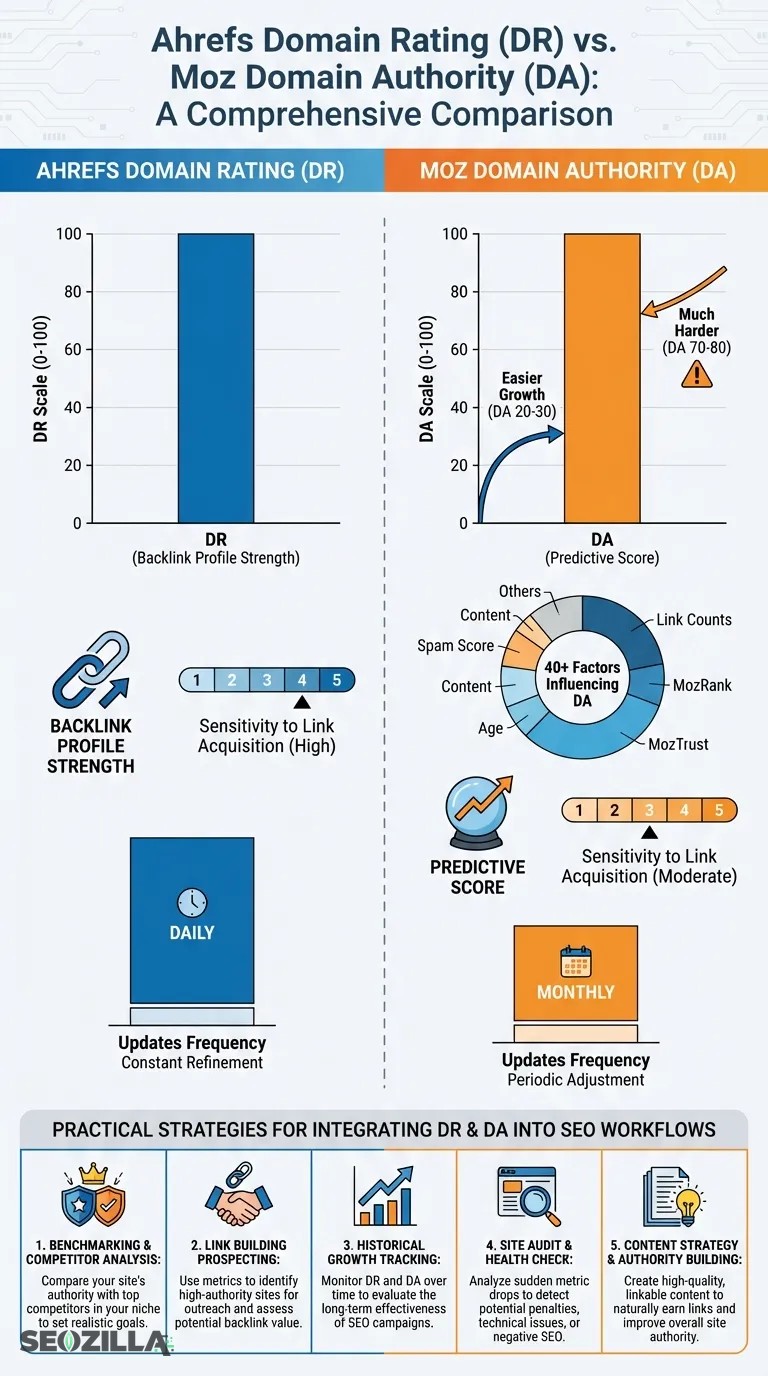
Moz Domain Authority (DA) is a predictive score that estimates a domain’s likelihood of ranking in Google search results. It uses over 40 factors, including link profile quality, linking root domains, spam score, and machine learning models trained on historical SERP data. The scale is logarithmic, meaning moving from DA 70 to 80 is exponentially harder than moving from DA 20 to 30. Moz’s model also considers the strength of your internal linking structure, the topical relevance of inbound links, and the overall trustworthiness of your domain compared to others in its index. This means that because DA is built to be comparative, it works best when analyzing multiple domains in the same niche rather than treating it as an absolute indicator of SEO success.
Compare this with Ahrefs Domain Rating (DR), which is focused purely on backlink profile strength. It evaluates the quantity, quality, and distribution of referring domains. A key distinction is that DR is updated daily, whereas DA is updated monthly. Importantly, DR ignores on-page SEO factors, keyword optimization, and spam signals. Ahrefs calculates DR by considering how many unique domains link to your site, the DR scores of those linking domains, and how those links are distributed across the web. This means a site with fewer but highly authoritative backlinks can outrank a site with many low-quality links in DR terms.
Another notable difference is that DR is more sensitive to recent link acquisition or loss, which can make it a valuable early warning system for link-building campaigns or negative SEO attacks.
| Metric | DA | DR |
|---|---|---|
| Primary focus | Holistic ranking potential | Backlink strength |
| Factors considered | >40 including spam score | Quantity and quality of referring domains |
| Update frequency | Monthly | Daily |
As you will have already noticed, DR is link-centric, while DA takes a broader view of domain authority. This difference is crucial when setting SEO priorities; a high DR but low DA could signal backlink strength without corresponding on-page optimization, while the reverse might indicate strong technical and content signals but a weak link profile.
Correlation with Rankings: Does Ahrefs DR or Moz DA Predict Performance?
Recent research has highlighted the predictive power of each metric. A study by Onely found that DA had a correlation coefficient of 0.16 with Google rankings, while DR had 0.14 – both weak predictors when used alone. This suggests that while both metrics can be part of the SEO puzzle, they should absolutely not be mistaken for direct ranking factors. In fact, the State of Backlinks Report 2025 revealed that websites with DR > 70 had 3.5x more referring domains than those with a DR under 30, which in turn often correlated with stronger visibility for competitive keywords.
When interpreting these correlations, it’s important to remember that Google’s algorithm uses hundreds of signals, and link authority is just one of them. A domain with high DR but poor Core Web Vitals, thin content, or weak topical authority might still struggle to rank. Conversely, a site with moderate DA and DR but exceptional relevance and content depth can outperform larger competitors.
In practice, marketers often use DA and DR as filtering tools. For example, when prospecting for backlinks, they may target sites above a certain DR threshold to ensure link equity, while using DA to gauge overall competitive potential in SERPs. So if you’re looking to future-proof your SEO strategy for 2026, the takeaway is very clear: use DA and DR in combination with other KPIs such as organic traffic growth, keyword rankings, and conversion metrics for a well-rounded performance analysis.
For a more in-depth look at backlink strategies, have a look at our Backlink Monitoring Checklist for Founders in 2025.
Expert Opinions on Whether Ahrefs DR is the Same as Moz DA
Industry experts have been quick to emphasize that neither DA nor DR is part of Google’s ranking algorithm.
Neither DA nor DR is a ranking factor in Google’s algorithm. They’re third-party metrics to help marketers benchmark authority.
Tim Soulo, CMO of Ahrefs, has been clear: DR is designed to measure backlink strength, nothing more. He often advises marketers to focus on acquiring high-quality referring domains rather than obsessing over incremental DR changes. Britney Muller, SEO consultant and former Moz evangelist, notes that DA is great for competitive landscapes but that it is still just a model; its accuracy depends on the size and freshness of Moz’s index.
Experts also point out that DA can fluctuate based on changes in Moz’s model or index size, even if your site’s SEO profile remains constant. Likewise, DR can dip if authoritative sites linking to you lose their own backlinks, even without any change to your site. This reinforces the need to interpret these scores in context rather than as isolated performance measures.
Practical Applications for Ahrefs DR and Moz DA in Digital Marketing
Understanding when to use DA vs DR can go a long way towards streamlining (and scaling) your SEO strategy.
When Should You Use DA?
- Competitive keyword analysis: DA can help assess whether your domain is likely to compete for certain keywords against established players.
- Holistic domain benchmarking: Use DA to evaluate your site’s overall standing compared to competitors, factoring in a broader range of ranking signals.
- Reporting to non-technical stakeholders: DA’s holistic nature makes it easier to explain to clients or executives as a single-number snapshot of domain strength.
When Should You Use DR?
- Link-building campaign targeting: DR is ideal for identifying domains with strong backlink profiles that can pass significant link equity.
- Evaluating backlink opportunities: A high DR score often indicates a more valuable backlink, though relevance still matters.
- Competitive backlink gap analysis: Comparing DR scores between you and competitors can reveal where your link profile falls short.
Combining both these metrics into your workflow will really help ensure you don’t overlook opportunities or misinterpret data. For instance, a site with a DR of 75 but a DA of 45 might be a powerhouse in backlinks but lacking in content optimization, presenting an opportunity for partnership if your strategy focuses on co-created content that improves the authority of both parties.
If you’re interested in learning more about integrating metrics into campaigns, see our guide on Navigating the Future of SEO Trends and Predictions.
AI-Driven Integration: How Ahrefs DR and Moz DA Fit In
Modern SEO tools now integrate AI-based predictive ranking models, blending DA, DR, and real-time SERP data. This multi-metric approach offers a far more nuanced view of a site’s competitive position. As we well know, AI can process vast datasets quickly, identifying patterns that humans might miss, such as detecting that a sudden rise in DR is due to a viral PR campaign that may or may not be sustainable in the long term.
For example, AI can flag domains with high DR but low DA, indicating strong backlink profiles but weak on-page optimization. This helps marketers prioritize their efforts. Conversely, AI can spot sites with moderate DR but exceptional DA, suggesting that their authority is driven more by content and topical relevance than raw link power. This is powerful intel for marketers, as integrating these insights into content planning, outreach targeting, and technical SEO audits enables a more strategic allocation of resources.
Case Study: Multi-Metric Outreach Campaign
Let’s bring some real-world context to the table by looking at an outreach campaign targeting guest posting opportunities. By filtering prospects with DA > 50 and DR > 60, one agency improved average referral traffic by a very healthy 27% over three months. This dual filter ensured that partners had both a strong backlink profile and a solid holistic authority, significantly increasing the likelihood that backlinks would be both powerful and contextually relevant.
The agency also noted that using both metrics reduced wasted outreach. Before implementing the filter, many hours were spent contacting sites with high DR but irrelevant or low-quality content. After adding DA as a second filter, outreach efforts were far better aligned with the client’s niche, resulting in higher acceptance rates and stronger referral engagement. What’s more, the client’s own DA and DR improved in tandem over time, demonstrating the compounding effect of targeted link acquisition from well-rounded domains.
| Metric | Before | After |
|---|---|---|
| Avg. referral traffic | 1,200/month | 1,524/month |
| Qualified prospects | 85 | 112 |
Common Pitfalls in Using Ahrefs DR and Moz DA
One common mistake is treating DA or DR as gospel. Remember: both are purely data-driven estimates, and their value lies in trend analysis, not absolute scores. As such, we highly recommend marketers avoid making decisions based solely on one metric, as this can lead to missed opportunities or misguided efforts. For example, rejecting a backlink from a DR 45 site because it’s “too low” might cause you to miss out on a highly relevant link that drives qualified traffic.
Another pitfall is ignoring update cycles. DR changes daily, while DA updates monthly, so timing absolutely matters when reporting or comparing results. A sudden DR drop might be a temporary fluctuation, while a DA increase could reflect a model update rather than an actual improvement in SEO. Additionally, focusing on vanity metrics without considering ROI can seriously derail campaigns: a link that boosts DR but brings no traffic or conversions is less valuable than one with measurable business impact.
The Future of Ahrefs DR and Moz DA: 2026 and Beyond
As 2025 comes to a close and we step into 2026, expect greater emphasis on link quality analysis, with DR supplemented by AI-driven spam detection. This will help marketers more effectively distinguish between genuine editorial backlinks and manipulative link schemes. DA models will likely also start incorporating more real-time data, narrowing the gap in update frequency and making the metric more responsive to recent SEO changes.
SEO professionals will continue moving toward multi-metric dashboards that integrate DA, DR, organic traffic, keyword rankings, and topical authority scores. As search engines evolve, there may also be a shift toward measuring “entity authority,” where brand recognition and knowledge graph presence influence rankings more than raw link numbers.
And while we sadly don’t have a crystal ball, we know one thing for sure: Marketers who adapt early to these blended authority models will have a distinct competitive edge, leveraging DA and DR as part of a broader authority-building strategy that includes PR, content marketing, and social proof.
Troubleshooting Metric Discrepancies in Ahrefs DR and Moz DA
If you notice a large gap between DA and DR for a domain, we encourage you to investigate:
- Backlink quality: A high DR but low DA could indicate strong links but poor on-page or technical SEO.
- On-page SEO health: Weak content optimization, slow load speeds, or poor mobile usability can suppress DA.
- Spam score: A high spam score in Moz could lower DA even if DR remains strong.
Other factors include differences in index size and freshness between Moz and Ahrefs. For example, Ahrefs might have discovered a batch of new backlinks that Moz has yet to index, temporarily boosting DR ahead of DA. Cross-referencing with Google Search Console link data can therefore help validate which metric is more accurate in a given scenario. By documenting these discrepancies over time, you can reveal patterns that inform your SEO strategy.
Summary: Why Ahrefs DR and Moz DA Matter in 2026
The debate may rage on, but we think it’s pretty clear: DA and DR are different tools in your SEO toolkit, measuring distinct aspects of domain strength. While DR shines for link-building analysis, DA offers a broader competitive view. Both have value and should be used together for the best results, but neither should be treated as a direct ranking factor.
Instead, think of DR as your lens for evaluating link equity potential and DA as your gauge for overall competitive positioning. Integrating both will provide a more complete picture of your domain’s authority landscape, helping you make smarter, more informed decisions about where to invest your time, budget, and creative resources to drive more sustainable growth. This means not only tracking your own scores but also benchmarking against competitors, segmenting targets based on combined thresholds, and correlating changes with tangible SEO outcomes.
So what’s the next move? In 2026, we predict that the most successful SEO strategies will integrate multiple metrics, leverage AI for more meaningful insights, and focus on actionable data. So, audit your top competitor’s DA and DR, overlay that data with your own, and identify gaps you can close through targeted content, link-building, and technical optimization. The smarter your metric integration, the more agile and resilient your SEO strategy will be.